| “출산은 개인이 아닌 도시의 책임”… 민형배, ‘3無·3대 책임 정책’으로 전남·광주 판을 바꾼다 분만비·산후조리·출산준비금 ‘완전 제로’… 24시간 아동의료·돌봄 혁명 선언 ai호남뉴스 박충배 편집/칼럼/논설 aihnnewsr@kakao.com |
| 2026년 03월 31일(화) 16:53 |
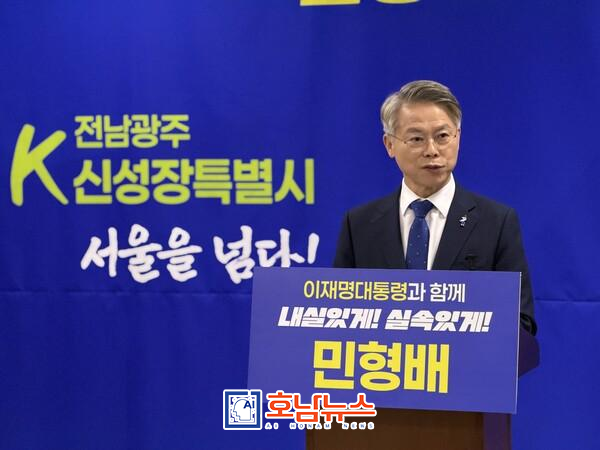 민형배 전남광주특별시장 예비후보 / 사진제공=민형배의원실 |
전남·광주 통합특별시를 둘러싼 정책 경쟁이 ‘출산·육아 국가책임 시대’로 급격히 이동하고 있다.
더불어민주당 전남광주통합특별시장 경선 후보인 민형배 국회의원(광주 광산구을)이 ‘출산·육아·생활 3대 책임 정책’을 전격 발표하며, 저출산 대응의 패러다임 전환을 선언했다.
민 의원은 31일 정책 발표를 통해 “출산과 육아는 더 이상 개인의 선택과 희생에 맡길 문제가 아니다”라며 “아이를 낳는 순간부터 성장까지 도시와 공동체가 책임지는 구조로 완전히 바꾸겠다.”고 밝혔다.
■ “출산 비용 0원 시대”… ‘출산 3無 정책’ 전면 도입
이번 정책의 핵심은 출산 부담을 원천적으로 제거하는 ‘출산 3무(無)’ 시스템이다.
민 의원은 ▲분만 병원비 본인부담금 전액 지원 ‘분만비 ZERO’ ▲공공 산후조리원 무료 및 민간 이용 시 250만 원 지원 ‘산후조리 ZERO’ ▲출생 즉시 100만 원 지급 ‘출산 준비금 ZERO’ 도입을 제시했다.
이는 출산 과정에서 발생하는 경제적 장벽을 완전히 제거해, “아이를 낳는 순간 비용 걱정부터 시작되는 구조를 끝내겠다”는 강력한 메시지다.
■ “아이 아프면 국가가 책임진다.”… 24시간 아동의료·돌봄 체계 구축
육아 정책은 ‘불안 제로’에 초점이 맞춰졌다.
전남·광주 27개 시·군·구에 아동 전담 거점 병원을 지정하고 24시간 진료체계를 구축하는 한편, 소아과 공백 지역에는 보건소와 지방의료원을 활용해 의료 접근성을 획기적으로 끌어올릴 계획이다.
특히 병원 동행과 간병을 지원하는 ‘병원아동보호사’ 제도를 도입하고, 공공·민간 전반에 ‘아이 돌봄 휴가제’를 확대해 부모 부담을 구조적으로 분산시킨다는 구상이다.
■ “독박육아 끝낸다.”… 지역 기반 돌봄 혁명
민 의원은 부모 개인에게 집중된 돌봄 부담을 지역사회로 분산시키는 ‘육아 구조 혁신’도 제시했다.
보건소와 공공시설을 활용한 ‘육아 만가지 궁금센터’를 상설 운영하고, 발달 전문가가 직접 찾아가는 영유아 지원 서비스를 도입한다.
또한 공동육아 공간 확대와 기존 돌봄시설의 통합 운영, 이용 시간 확대를 통해 ‘언제든 맡길 수 있는 돌봄 도시’를 구축하겠다는 방침이다.
■ “아이 키우는 도시가 미래를 가진다”… 창의문화 도시 전략
전남·광주를 ‘어린이 중심 도시’로 전환하는 문화 전략도 포함됐다.
민 의원은 국립아시아문화전당 어린이문화원 모델을 기반으로 권역별 창의 놀이터를 확대하고, ‘창의 놀이 활동가(플레이메이커)’를 양성해 아이들의 성장 환경을 혁신하겠다고 밝혔다.
이를 통해 전남·광주 전역을 연결하는 ‘창의 놀이 벨트’를 구축한다는 구상이다.
■ “아이와 부모가 편한 도시”… 생활환경까지 전면 개편
생활 인프라 역시 출산·육아 친화 구조로 재편된다.
유아차 이동이 편리한 ‘걷고 싶은 거리’ 30곳을 조성하고, 행정·생활·수익 기능을 결합한 ‘전남광주 슈퍼앱’을 구축해 데이터와 광고 수익을 시민과 공유한다는 계획이다.
여기에 ‘남도패스’와 교통비 반값 정책을 결합해 도시와 농촌 간 이동 격차까지 해소하겠다는 구상도 포함됐다.
■ “아이 웃음이 도시 경쟁력”… 패러다임 전환 선언
민형배 의원은 “저출산은 복지 문제가 아니라 도시 생존의 문제”라며 “출산·보육·생활 전반을 도시가 책임지는 구조로 전환하지 않으면 미래는 없다”고 강조했다.
이어 “부모가 웃고 아이가 자라며 공동체가 지속되는 도시, 그것이 전남·광주 통합특별시의 경쟁력이 될 것”이라며 “출산부터 삶의 질까지 책임지는 ‘완전한 가족 도시’를 실현하겠다.”고 밝혔다.
이번 정책은 단순한 복지 확대를 넘어, ‘도시가 아이를 키운다’는 새로운 시스템 경쟁의 신호탄으로 평가된다.
“Childbirth Is Not a Private Burden but a City’s Responsibility”… Min Hyung-bae Unveils ‘Zero-Cost Birth & 3-Pillar Responsibility Policy’ to Transform Gwangju–Jeonnam
Subheadline: Full coverage for delivery, postpartum care, and childbirth grants… 24-hour pediatric care and childcare revolution
Subheadline: “Children’s smiles are the city’s competitiveness”… Building a full lifecycle responsibility system for birth, childcare, and living
【Jeonnam·Gwangju = AI Honam News】 aihnnews@kakao.com
Policy competition surrounding the Gwangju–Jeonnam Integrated Special City is rapidly shifting toward a “state responsibility era” for childbirth and childcare.
Min Hyung-bae, a candidate in the Democratic Party primary for mayor of the proposed Gwangju–Jeonnam Integrated Special City and a National Assembly member (Gwangsan-gu, Gwangju), announced a comprehensive “Three-Pillar Responsibility Policy” covering childbirth, childcare, and daily life—signaling a paradigm shift in addressing South Korea’s low birthrate crisis.
Speaking at the policy announcement on the 31st, Rep. Min stated, “Childbirth and childcare can no longer be left to individual choice and sacrifice,” adding, “We will fundamentally transform the system so that cities and communities take responsibility from the moment a child is born through every stage of growth.”
■ “The Era of Zero-Cost Childbirth”… Full Implementation of ‘Three-Zero Birth Policy’
At the core of the policy is a “Three-Zero” system designed to eliminate financial burdens associated with childbirth.
Rep. Min proposed:
Full coverage of out-of-pocket delivery costs (“Delivery Cost ZERO”)
Free access to public postpartum care centers or a KRW 2.5 million voucher for private facilities (“Postpartum Care ZERO”)
A KRW 1 million childbirth grant 지급 immediately after birth (“Childbirth Preparation ZERO”)
This initiative aims to remove economic barriers entirely, sending a clear message: “We will end the reality where financial concerns begin the moment a child is born.”
■ “If a Child Falls Ill, the State Responds”… 24-Hour Pediatric Care System
Childcare policy focuses on eliminating anxiety for parents.
The plan includes designating specialized pediatric hub hospitals across all 27 cities and counties in the Gwangju–Jeonnam region, establishing a 24-hour treatment system. In underserved areas lacking pediatric clinics, public health centers and regional medical institutions will be utilized to close healthcare gaps.
In addition, a new “Hospital Childcare Assistant” program will provide accompaniment and caregiving support for children receiving treatment, while an expanded “Childcare Leave System” will be introduced across both public and private sectors to ease parental burden.
■ “Ending Solo Parenting”… A Community-Based Childcare Revolution
Rep. Min also proposed structural reforms to redistribute childcare responsibilities from individuals to the community.
Key measures include:
Permanent operation of “All-in-One Parenting Support Centers” using public health centers and facilities
Deployment of mobile early childhood development support services led by specialists
Expansion of shared childcare spaces and integration of existing care facilities with extended operating hours
These initiatives aim to create a “city where childcare is always accessible.”
■ “Cities That Raise Children Will Lead the Future”… Creative Culture Strategy
A cultural transformation toward a child-centered city is also part of the plan.
Rep. Min aims to expand regional creative playgrounds modeled after the Asia Culture Center Children’s Museum and train “Playmakers” to foster children’s development through play.
This will culminate in the creation of a region-wide “Creative Play Belt” across Gwangju and Jeonnam.
■ “A City Comfortable for Both Children and Parents”… Comprehensive Living Environment Reform
Urban infrastructure will also be redesigned to support families.
Plans include developing 30 stroller-friendly “walkable streets,” launching a “Gwangju–Jeonnam Super App” integrating administrative, lifestyle, and revenue-sharing functions, and distributing data and advertising profits back to citizens.
Additionally, the introduction of a “Namdo Pass” and a half-price public transportation policy will enhance mobility between urban and rural areas.
■ “Children’s Smiles Define Urban Competitiveness”… A Paradigm Shift
Rep. Min emphasized, “Low birthrates are not merely a welfare issue but a matter of urban survival,” warning that “without transitioning to a system where cities take full responsibility for childbirth, childcare, and daily life, there is no future.”
He added, “A city where parents are happy, children thrive, and communities endure—that is the true competitiveness of the Gwangju–Jeonnam Integrated Special City.”
This policy goes beyond welfare expansion, marking the beginning of a new era in which “cities raise children” as part of a systemic competition for the future.
 ai호남뉴스 박충배 편집/칼럼/논설 aihnnewsr@kakao.com