| “서울을 넘는다”… 민형배, 320만 시민 메가시티 ‘전남·광주 통합특별시 5대 혁명 공약’ 전격 선언 부제: 성장·균형·기본·녹색·시민주권… “대한민국 미래 판을 바꾸는 남부권 대전환 설계도” ai호남뉴스 박충배 편집/칼럼/논설 aihnnewsr@kakao.com |
| 2026년 04월 02일(목) 16:58 |
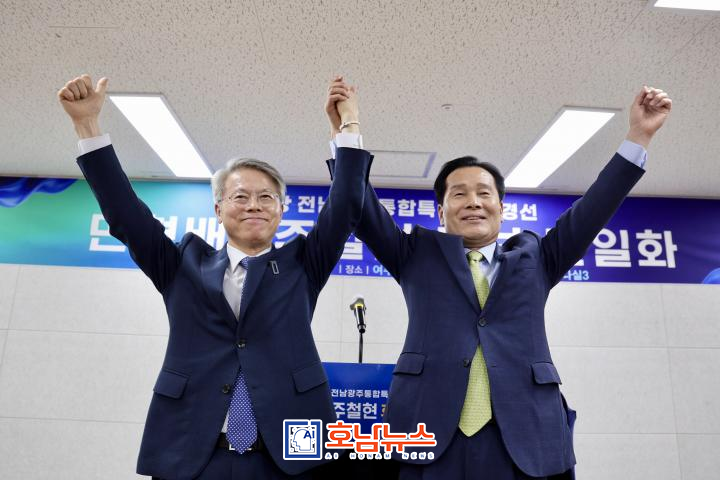 주철현의원과 민형배의원 전남광주특별시장 예비후보 단일화 / 사진제공=민형배의원실 |
전남·광주 통합특별시를 둘러싼 정책 경쟁이 ‘국가 구조 재편’ 수준으로 격상됐다.
더불어민주당 전남·광주 통합특별시장 경선 후보 민형배 국회의원이 ‘서울을 넘어서는 남부권 메가시티’ 구축을 목표로 한 5대 핵심 공약을 전격 발표하며, 통합특별시의 방향을 ‘생존을 넘어 미래 설계’로 끌어올렸다.
민 후보는 “이제 통합은 선택이 아니라 시대적 필연”이라며 “성장·균형·기본·녹색·시민주권을 중심으로 전남·광주를 대한민국의 미래 중심축으로 재편하겠다.”고 밝혔다.
■ “청년이 떠나지 않는 도시”… 성장통합으로 산업 판 뒤집는다
민형배 후보는 첫 번째 전략으로 ‘성장통합’을 제시하며, 전남·광주를 대한민국 남부권 신산업 수도로 만들겠다는 구상을 밝혔다.
AI·에너지·우주·바이오·모빌리티·반도체·신소재 등 미래 핵심 산업을 연결한 ‘초광역 산업벨트’를 구축하고, 청년이 지역에서 배우고 일하며 다시 도전할 수 있는 구조를 완성하겠다는 것이다.
특히 ‘청년 AI 뉴딜’과 청년특별기금 조성을 통해 기술 기반 일자리와 창업 생태계를 동시에 확장하고, 농산어촌까지 소득과 일자리가 확산되는 ‘전방위 성장 구조’를 설계하겠다고 강조했다.
■ “어디에 살아도 손해 없는 도시”… 균형통합으로 지역 갈등 해소
두 번째 축은 ‘균형통합’이다.
민 후보는 통합특별시 출범 과정에서 가장 큰 쟁점으로 떠오른 ‘지역 간 불균형 우려’를 정면으로 돌파하겠다는 입장이다.
이를 위해 ▲균형발전 특별회계 설치 ▲농산어촌 및 섬 지역 최소보장·우선지원 제도화 ▲지역 권익 보호의 법적 명문화 등을 추진한다.
또 동부·서부·중남부·광주권을 기능적으로 분업화하고 순환경제 구조로 연결해 ‘경쟁이 아닌 역할 기반 성장 체계’를 구축하겠다고 밝혔다.
■ “불안 대신 도전”… 기본소득으로 삶의 안전망 구축
세 번째 전략은 ‘기본소득’이다.
민 후보는 AI와 기술 전환 시대의 불안정성을 지적하며, 최소한의 삶을 보장하는 ‘도전 가능한 사회’로의 전환을 강조했다.
청년·소상공인·농어민을 대상으로 한 도전 안전망 구축과 함께, 에너지 산업 수익을 지역과 시민이 공유하는 ‘에너지 기본소득 모델’을 확대하겠다는 구상이다.
이는 단순 복지를 넘어 ‘산업과 소득이 연결되는 구조적 전환’으로 평가된다.
■ “에너지가 도시를 만든다.”… 녹색도시로 국가 경쟁력 재편
네 번째는 ‘녹색도시 전략’이다.
민 후보는 해상풍력과 태양광을 기반으로 한 에너지 허브 구축과 RE100 산업벨트 조성을 통해 전남·광주를 ‘에너지 자립형 도시’로 전환하겠다고 밝혔다.
또 ▲30분 생활권·60분 광역교통망 ▲물순환 회복 및 복개하천 복원 ▲기후재난 대응 체계 강화 ▲생태정원도시 및 치유관광 특구 조성 등을 통해 기후위기에 대응하는 생활환경 혁신을 추진한다.
이는 단순 환경 정책이 아닌, 산업과 도시 구조를 동시에 바꾸는 ‘녹색 성장 전략’으로 해석된다.
■ “권력은 시민에게”… 시민주권 통합으로 도시 운영 방식 혁명
다섯 번째는 ‘시민주권 통합’이다.
민 후보는 “통합특별시는 행정이 아니라 시민이 설계하는 도시여야 한다.”며 권력 구조 자체의 전환을 선언했다.
이를 위해 ▲27개 시군구 및 393개 읍면동 자치권 강화 ▲온라인 시민참여 플랫폼 상시 운영 ▲정책·예산·통합 과정 전면 공개 등을 추진한다.
이는 ‘대표 민주주의를 넘어 참여 민주주의로의 진입’을 의미하는 구조적 변화로 평가된다.
■ “통합은 선언이 아니라 실행”… 국가 미래 바꾸는 실험 시작
민형배 후보는 이번 공약 발표를 통해 전남·광주 통합특별시를 단순 행정통합이 아닌 ‘대한민국 구조 전환 프로젝트’로 규정했다.
그는 “수도권 일극 체제를 넘어서는 새로운 성장 축을 만들어야 한다.”며 “전남·광주가 성공하면 대한민국의 미래가 바뀐다. 이제 판은 이미 움직이기 시작했다”고 강조했다.
이번 5대 공약은 산업, 복지, 환경, 권력 구조까지 전면적으로 재설계하는 ‘통합특별시 종합 설계도’로 평가되며, 향후 경선 판도와 정책 경쟁의 핵심 기준으로 작용할 전망이다.
“Surpassing Seoul”… Min Hyung-bae Unveils ‘Five Revolutionary Pledges’ for a 3.2 Million-People Mega City in the Jeonnam–Gwangju Integrated Special City
Subheadline: Growth, Balance, Basic Income, Green Transition, and Civic Sovereignty… “A Grand Blueprint to Reshape Korea’s Future from the South”
【Jeonnam·Gwangju = AI Honam News】 aihnnews@kakao.com
The policy competition surrounding the Jeonnam–Gwangju Integrated Special City has escalated to the level of restructuring the national framework.
Min Hyung-bae, a National Assembly member and candidate in the Democratic Party’s primary for mayor of the integrated special city, has unveiled five core pledges aimed at building a “southern mega city that surpasses Seoul,” elevating the vision of integration from mere survival to a comprehensive future blueprint.
“The integration is no longer an option but a historical necessity,” Min stated. “With growth, balance, basic income, green transition, and civic sovereignty, we will reposition Jeonnam and Gwangju as a central axis of Korea’s future.”
■ “A City Where Youth Stay”… Transforming Industry Through Growth Integration
As his first strategy, Min proposed “growth integration,” aiming to establish Jeonnam and Gwangju as the industrial capital of southern Korea.
He plans to build a “super-regional industrial belt” linking future industries such as AI, energy, aerospace, biotechnology, mobility, semiconductors, and advanced materials. The goal is to create a system where young people can study, work, and take on new challenges within the region.
In particular, he emphasized launching a “Youth AI New Deal” and establishing a special youth fund to expand tech-based jobs and startup ecosystems, while spreading income and employment opportunities to rural and fishing communities.
■ “A City Where No Region Is Left Behind”… Resolving Inequality Through Balanced Integration
The second pillar is “balanced integration.”
Min aims to directly address concerns about regional inequality, one of the biggest issues surrounding the integration process.
His plan includes establishing a special balanced development fund, institutionalizing minimum guarantees and priority support for rural and island areas, and legally protecting regional rights.
He also proposed designing a functional division of roles among eastern, western, central-southern, and Gwangju regions, connecting them through a circular economic system to build a “role-based cooperative growth structure.”
■ “From Anxiety to Opportunity”… Building a Safety Net Through Basic Income
The third strategy focuses on “basic income.”
Highlighting the instability of the AI and technological transition era, Min stressed the need for a society where people can prepare for the future with a guaranteed minimum standard of living.
He plans to establish safety nets for youth, small business owners, and farmers/fishers, while expanding an “energy basic income model” that shares energy industry profits with local communities and citizens.
This approach is seen not merely as welfare, but as a structural shift linking industry and income.
■ “Energy Builds Cities”… Rebuilding National Competitiveness Through a Green Transition
The fourth pillar is the “green city strategy.”
Min proposed creating an energy hub based on offshore wind and solar power, along with a RE100 industrial belt, transforming Jeonnam and Gwangju into energy self-sufficient cities.
He also outlined plans for a 30-minute living zone, a 60-minute regional transportation network, restoration of water circulation and covered streams, strengthened climate disaster response systems, and the development of eco-garden cities and healing tourism zones.
This is interpreted as a “green growth strategy” that reshapes both industry and urban structure.
■ “Power to the People”… Revolutionizing Governance Through Civic Sovereignty
The fifth pillar is “civic sovereignty integration.”
Min declared, “The integrated special city must be designed by citizens, not dictated by administration,” signaling a fundamental shift in governance.
His plan includes strengthening autonomy in 27 cities/counties/districts and 393 towns and villages, operating an always-on online civic participation platform, and fully disclosing policies, budgets, and integration processes.
This represents a structural transition from representative democracy to participatory democracy.
■ “Integration Is Execution, Not Declaration”… A New Experiment to Transform Korea’s Future
Through these pledges, Min defined the Jeonnam–Gwangju Integrated Special City not as a simple administrative merger, but as a “national transformation project.”
“We must create a new growth axis beyond the capital-centric system,” he said. “If Jeonnam and Gwangju succeed, Korea’s future will change. The game has already begun to move.”
The five pledges are being evaluated as a comprehensive blueprint that redesigns industry, welfare, environment, and governance, and are expected to become a key benchmark in the ongoing primary race and policy competition.
 ai호남뉴스 박충배 편집/칼럼/논설 aihnnewsr@kakao.com